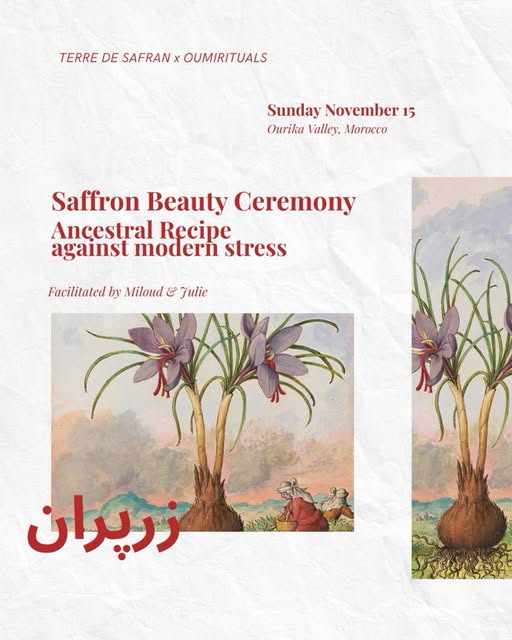
Why is saffron so precious?
Saffron is the dried stigma of the Crocus sativus flower. Each flower has only three red threads, separated by hand on the day of harvest. That is why it is often called red gold: it takes around 150 flowers for a single gram. Morocco's best-known saffron region is Taliouine, near Taroudant, and the crop is now also grown in the Ourika Valley, close to Marrakech.
When is saffron season in Morocco?
The crocus blooms in autumn, usually from late October to November. Flowers are picked early in the morning, before the sun opens them, then the stigmas are dried. Outside the season you can still visit the fields and learn how the bulbs are grown.
What does a saffron day in the Ourika Valley look like?
- Leave Marrakech in the morning towards the Atlas foothills.
- Walk the saffron fields with the growers of Terre de Safran and learn how the threads are harvested and graded.
- Take part in the ritual: a saffron mask and treatments prepared in a mortar, Moroccan-grandmother style.
- Head back with the recipes, and a few threads to use at home.
How to spot real saffron
- Real threads are deep red, trumpet-shaped at one end, and don't bleed colour instantly in water.
- Very cheap "saffron" in tourist souks is often safflower or dyed fibres.
- Buy from a grower or a trusted shop, never loose from an unlabelled pile.
Saffron masks are for external use only; tell us about allergies when you book.
Join the next Saffron Ceremony?
Book my ceremony →Frequently asked questions
How far is the Ourika Valley from Marrakech?
It sits in the High Atlas foothills south of Marrakech, an easy half-day or day trip by road.
When is saffron harvested in Morocco?
In autumn, usually late October to November, early in the morning.
Is the Saffron Ceremony in English?
Yes. Oumi Rituals ceremonies are hosted in English and French.